Un long nuage sur Mars
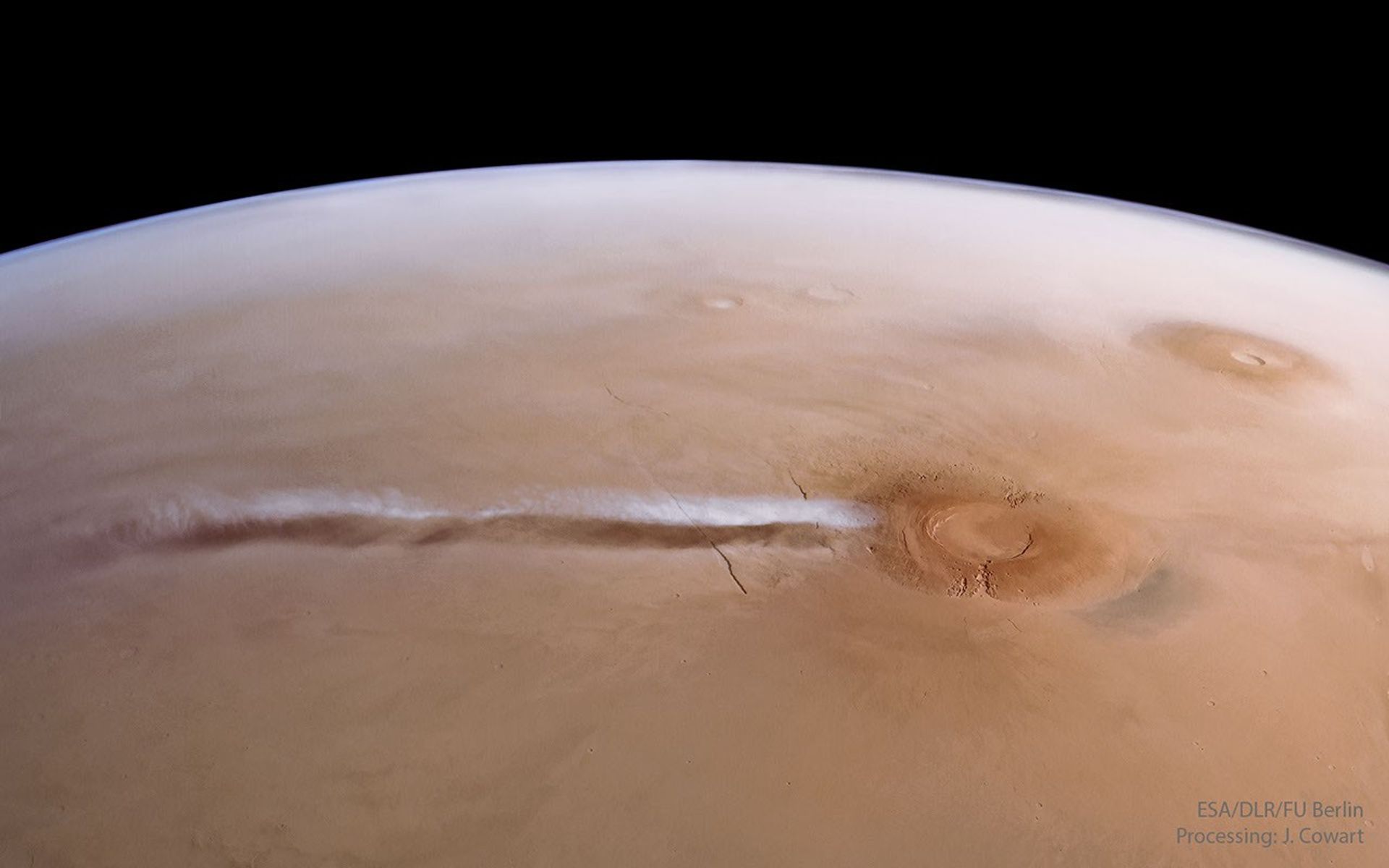
Qu'est-ce qui est à l'origine de ce nuage inhabituellement long sur Mars ? Connu sous le nom de nuage allongé d'Arsia Mons et observé pour la première fois par la sonde Viking Orbiter 2 de la NASA en 1977, cet étrange nuage a récemment fait l'objet d'images plus détaillées prises par la sonde Mars Express de l'Agence spatiale européenne. L'image présentée ici date de 2018. Ce nuage ne se forme qu'au printemps et en été, et uniquement le matin. Composé de glace d'eau, le processus classique par lequel des cristaux de nuage se forment autour de particules de poussière ne pourrait pas s'appliquer ici en raison de la rareté et de la faible concentration de poussière dans les couches supérieures de l'atmosphère martienne. L'hypothèse la plus courante est donc que la poussière n'intervient pas dans ce phénomène. Une fois que le nuage s'est formé près du volcan Arsia Mons, le vent le pousse en aval, créant ainsi une traînée pouvant s'étendre sur plus de 1 500 kilomètres. Les efforts visant à mieux comprendre ce type de phénomène se poursuivront, ce qui pourrait permettre d'affiner notre compréhension de la formation des nuages sur Terre.
L'image d'astronomie du jour (Astronomy Picture Of the Day - APOD)
Traduction réalisée par Didier Jamet
Ailleurs sur le web
Facts About Earth - NASA Science
While Earth is only the fifth largest planet in the solar system, it is the only world in our solar system with liquid water on the surface. Just slightly larger than nearby Venus, Earth is the biggest of the four planets closest to the Sun, all of which are made of rock and metal. Earth […]

science.nasa.gov
How Do Clouds Form? - NASA Science
You hang up a wet towel and, when you come back, it’s dry. You set out a bowl of water for your dog and when you look again, the water level in the bowl has
science.nasa.gov
Mars - NASA Science
Mars is a dusty, cold, desert world with a very thin atmosphere.
science.nasa.gov
Mars’s Most Mysterious Cloud Might Be Defying Textbook Cloud Physics
It may not be as obvious, but just like Earth, Mars has seasons. And every day of every summer, an 1,800 kilometer long thin white cloud appears to the west of Arsia Mons, a 20 kilometer high extinct shield volcano. At least for a few hours, before it dissipates until it reappears the next morning. Scientists have known about this feature, which they call the Arsia Mons Elongated Cloud (AMEC), for [...]

www.universetoday.com
ESA
The European Space Agency portal features the latest news in space exploration, human spaceflight, launchers, telecommunications, navigation, monitoring and space science.

www.esa.int
Mars Express
ESA's official Mars Express website features the latest news and status reports on Europe's spacecraft orbiting around Mars. See the latest images of Mars taken by Mars Express' instruments!
www.esa.int
Mars’s oddest cloud may be even odder than we thought
Scientists using the European Space Agency's Mars Express, in combination with a state-of-the-art meteorological model of the Red Planet, have found that there may be some very exotic physics behind Mars’s most curious cloud.
www.esa.int
Arsia Mons Cloud - Mars Express
Mars Express HRSC image of the volcano Arsia Mons with a ~1500 km orographic cloud that is forming downwind of the mountain. Although clouds are common in the region, this cloud is out of season. Clouds over Arsia Mons typically occur when Mars is furthest from the Sun (local summer), because the atmosphere is colder (closer to water's condensation point) and the northern ice cap supplies ample a [...]

www.flickr.com
GMS: Aerosols Impact Cloud Formation
Aerosols are complex particles; they occur in nature and can also be generated by human activity. One important new area of aerosol research involves how aerosols impact clouds. Without aerosols, clouds could not exist. Aerosol particles serve as condensation nuclei for water vapor in the atmosphere. Atmospheric water molecules are drawn to aerosol particles like magnets, forming water droplets an [...]

svs.gsfc.nasa.gov


 spaceplace.nasa.gov
 www.nature.com
 www1.grc.nasa.gov
 airbornescience.nasa.gov
 en.wikipedia.org